Look closely at the detritus currently occupying your yard: tangled, brown, leggy.
Left to their own devices, certain tenants of your garden believe they are popular enough to drag that look into summer. The audacity of nature. Besides, they’re wrong. They require a rigorous lesson in sophistication before springtime. Time to sharpen your pedagogical approach.
Over the years, I’ve learned that cutting the right plants back before spring growth starts makes a noticeable difference in how strong and healthy they look all year.
The Pruning Groups or When Your Shears Are Dangerous

Most flowering shrubs fall into one of these three pruning groups based on when they form their flower buds. Respect this, because I’ve learned the hard way that pruning at the wrong time can remove an entire season of blooms.
- Old Wood Bloomers set their buds on last year’s growth (usually during the previous summer or fall). These plants should only be pruned after they finish flowering in late spring or early summer.
- Repeat Bloomers generally need light cleanup rather than hard cuts. Focus your attention strictly on removing the dead wood and any weak or damaged tips. A hard prune is a no-go, as it sacrifices their first, often larger, round of blooms.
- New Wood Bloomers are the ones we focus on now. They create and set their flower buds exclusively on the growth they produce in spring and summer. These are the plants that respond best to late-winter pruning, which encourages strong new stems and better flowering later in the season.
Sharpen your tools, put on your most judgmental gardening hat, and get chopping.
The Only Time Cutting Back STEM Works

Quick reminder: These cuts apply once snow has melted and the plant structure is visible. If your plants are still buried under snow, wait until it clears before doing anything.
Past glory is irrelevant. Apply the logic of the shears once the plant is accessible.
1: The Hybrid Tea Rose (USDA Zones 5-9)

Hybrid tea roses benefit from firm annual pruning because delaying it often leads to weak, spindly stems and reduced flowering. So, how to cut your roses?
First, cut out every all thin, damaged, or crossing cane at the base. Then reduce the remaining main canes down about 8-12 inches above the soil, cutting just above a healthy, outward-facing bud. That’s it!
In colder areas within these zones, I recommend staying closer to the higher end of that range to help protect against late cold snaps.
Quick tip: I usually wait until buds begin to swell and the risk of hard freezes has passed before pruning, which has consistently given me stronger spring growth.
If you’re working on roses this month, I also put together a full list of rose care tasks for February that go beyond pruning and help set them up for spring growth.
2: Hydrangeas (USDA Zones 3-8)

Paniculata and arborescens hydrangeas respond well to late-winter pruning because they flower on new growth produced in spring. The objective? Controlling size and encouraging strong stems to support the top-heavy blooms that arrive later.
I usually reduce their height by up to one-third. If additional size control is needed, I cut slightly more while focusing on shaping the plant and removing weak or crowded growth. This is especially useful for varieties known for heavy flower heads.
Quick reminder: These recommendations apply only to panicle and smooth hydrangeas (such as ‘Limelight’ or ‘Annabelle’), not to bigleaf or mountain types, which should not be pruned this way.
Pruning is just one part of February hydrangea care. If you want the full checklist, I’ve shared the essential hydrangea tasks I focus on this time of year in a separate guide.
3: Clematis (USDA Zones 4-9)

The pruning deadline approaches, and you cannot afford to miss it! Your goal is Clematis Group 3 varieties because they bloom on new growth produced in the current season.
Pruning at this stage prevents tangled growth and encourages strong, manageable vines later in the year.
Cut the plant back to the lowest set of healthy, plump buds (usually around 12-18 inches above the soil). Remove all dead or brittle stems so new shoots can grow without obstruction.
Quick tip: I remove all loose, dead stems first so I can clearly see where the healthy buds start before making final cuts.
If you’re not sure which type of clematis you have, one of our writers shows how she explains how to prune each Clematis group in detail and some care tips in this guide, so you can identify yours with confidence.
4: Spirea (Japanese Varieties) (USDA Zones 4-9)

Unlike many shrubs, Japanese spirea doesn’t require detailed structural cuts. Pruning in late winter encourages dense new growth and more consistent blooms throughout the season.
I cut the shrub back to about 6-12 inches above the ground, removing old, thick, or unproductive canes completely at the base.
Its naturally dense growth makes regular thinning especially important. So don’t skip it unless you’re okay with a crowded shrub and fewer blooms later in the season.
5: Caryopteris (USDA Zones 5-9)

Caryopteris (aka bluebeard) is a late bloomer, and it produces its beautiful (obviously) blue flowers solely on this spring’s growth. Leaving the old wood intact simply creates unnecessary clutter and prevents it from channeling its efforts into the strong shoots you require.
Cut the shrub back to about 6 inches above the ground, making cuts just above healthy dormant buds. Removing most of the old framework keeps the plant compact and prevents weak, leggy growth.
Quick tip: I usually wait until I can clearly see dormant buds before cutting, which helps me avoid trimming too low on colder winters.
6: Lavender (English Varieties) (USDA Zones 5-8)

English lavender should be pruned once you see the first signs of green growth emerging at the base. Unlike most shrubs, lavender isn’t pruned for structural strength but to prevent flopping and keep the plant compact.
Cut back only into the soft, flexible green growth from the previous season, avoiding the hard, woody base entirely. I remove about one-third to one-half of the green growth, it’s is usually enough for healthy regrowth.
Quick tip: I stop cutting as soon as I no longer see green tissue. Going any deeper is where most lavender pruning mistakes happen!
7: Russian Sage (USDA Zones 4-9)

Perhaps this perennial acts like a shrub, but Russian Sage has the structural integrity of dried spaghetti by late winter. Pruning now helps ensure that new growth is strong enough to support the plant’s tall, airy blooms later in summer.
Wait until the buds begin to swell, so you can clearly see where new growth will emerge. Then, cut the plant back to just above the lowest one or two healthy buds near the base.
I like to remove all dead stems first, then make my final cuts once the live buds are clearly visible, this helps keep the plant upright instead of floppy.
Quick reminder: Contrary to the severe reset you applied to the Clematis, you must be precise here. The plant’s dignified height and proportion depend on you.
8: Rose of Sharon (USDA Zones 5-9)

If you leave Rose of Sharon, (aka Hibiscus syriacus) alone, it becomes a gangly, sparsely flowering tree. And the goal is to encourage denser branching and more consistent flowering.
Start by removing a few of the oldest, thickest canes all the way down to the soil line to refresh the structure. Then cut back the remaining growth by about one-third to encourage fuller, lower growth and better bloom distribution.
9: Ornamental Grasses (USDA Zones 4-9)

The final, annual clean-up. Warm-season ornamental grasses. Throughout winter, these grasses add welcome texture, but leaving them in place too long can block emerging shoots and make spring growth harder to manage.
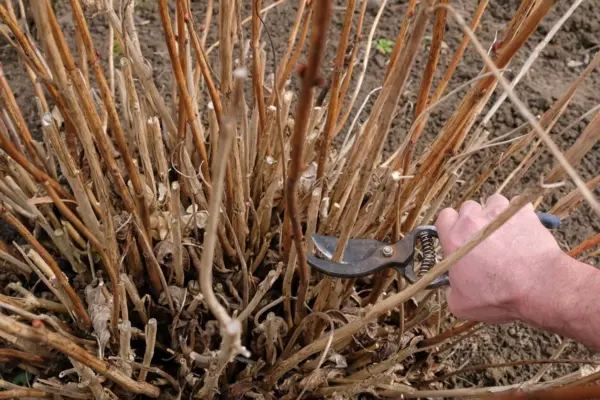
I like to tie the grass into a loose bundle before cutting, it keeps everything contained and makes cleanup much easier. Then I cut the grass back to about 4-6 inches above the ground, using sharp tools and making clean, deliberate cuts.
Do this before new green shoots start popping up, as it’s much easier to remove old material without damaging fresh growth.
Quick tip: If last year’s growth is stiff and straw-like rather than soft, it’s usually a warm-season grass and safe to cut back in late winter.
Not every perennial benefits from winter pruning, though. If you’re unsure what should stay untouched, I’ve also listed the perennials you should not cut back in February.
Tips a Cut Above the Rest

Ditch the fear of failure, embrace the sharp tools. You are not a butcher, you’re a botanical editor. And you’ve survived the hardest part: reading the rules. Now, grab the loppers and let the fate of your yard’s summer splendor rest entirely upon your sharp skills. No pressure