
For years, I assumed that washing dishes by hand was the cheaper option. After all, a dishwasher uses electricity, detergent tablets, and water every time it runs. Washing dishes in the sink seemed much simpler: turn on the tap, add a little dish soap, grab a sponge, and clean everything.
But then I started wondering: Was I actually saving money by washing dishes by hand, or was my dishwasher costing less than I thought?
To find out, I decided to try a simple 14-day experiment. Instead of running my dishwasher, I washed every plate, glass, cup, pan, and piece of cutlery by hand. I wanted to compare the water consumption, electricity costs, cleaning supplies, time spent, and overall convenience of both methods.
The results were more interesting than I expected. What seems like the cheaper method at first glance is not necessarily the one that saves the most money.
Here’s what I learned, what the numbers tell us, and how you can decide which method is best for your own household.
1. Why I Decided to Try the 14-Day Experiment
The idea behind this experiment was simple: compare two everyday ways of cleaning dishes and find out which one is more economical.
Dishwashers are often considered convenient but expensive appliances. They consume electricity to heat water, use special detergent, and sometimes require additional products such as rinse aid and dishwasher salt.
Handwashing, on the other hand, appears inexpensive because the supplies are relatively cheap and there is no appliance running in the background.
However, I realized that I had never properly calculated how much hot water I used while washing dishes in the sink.
Every time I left the tap running while rinsing plates, washed several pots, or cleaned greasy pans, I was using more water than I had imagined.
That made me curious about whether the dishwasher might actually be the more economical option.
2. How I Organized the Experiment
To make the comparison meaningful, I used a simple routine for 14 days.
During the experiment, I avoided running the dishwasher and washed all my everyday dishes manually.
I included:
- Dinner plates and breakfast plates.
- Glasses, mugs, and cups.
- Forks, spoons, and knives.
- Cooking pots and pans.
- Mixing bowls and food containers.
- Serving dishes and other kitchen utensils.
I also paid attention to how much hot water I used, how frequently I changed the washing water, how much dishwashing liquid I needed, and how long the entire process took.
The goal was not to claim that every household would get exactly the same results. Instead, I wanted to understand the costs behind each method.
For a fair comparison, it is important to remember that household size, water pressure, dishwasher efficiency, electricity prices, and personal washing habits can all change the final result.
3. The Biggest Surprise: Handwashing Can Use Much More Water
This was one of the most important things I discovered while looking into the numbers.
When you wash dishes by hand, it is easy to underestimate how much water disappears down the drain. A tap running for just a few minutes can use a surprisingly large amount.
The amount depends on how you wash:
- Leaving the tap running while scrubbing uses considerable water.
- Filling a washing-up bowl can reduce consumption.
- Washing several dishes together is usually more efficient than washing each item separately.
- Rinsing every dish under a continuously running tap can quickly increase water use.
A September 2026 comparison by the consumer organization Which? examined 33 recently tested dishwashers and compared their water consumption with an estimate for handwashing.
Here is what it found for 14 place settings:
| Washing method | Estimated water used |
|---|---|
| Handwashing | 63 litres |
| Dishwasher – main program | About 13 litres |
| Dishwasher – eco mode | About 10 litres |
That means the tested dishwashers used approximately 80–84% less water than the handwashing method in this comparison. Which?+1
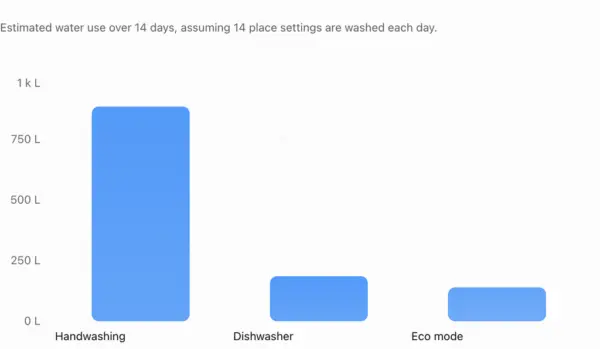
The difference becomes particularly interesting when you imagine repeating the same routine every day.
Illustration: 14 days of washing 14 place settings per day
Based on Which?’s estimated water consumption, not measurements from a personal household experiment.
Estimated water use over 14 days, assuming 14 place settings are washed each day.
0 L250 L500 L750 L1 k LHandwashingDishwasherEco mode
Under these assumptions, eco mode uses approximately 746 litres less water over 14 days than the handwashing comparison.
Of course, this is not a universal result. Someone who washes dishes carefully in a small basin and rinses efficiently may use much less water than someone who leaves the tap running.
But it shows why handwashing is not automatically the cheaper option.
4. What About Electricity? This Is Where Things Get Interesting
TO CONTINUE READING THE ARTICLE PLEASE SEE PAGE 2
4. What About Electricity? This Is Where Things Get Interesting
At first, electricity seems like the biggest disadvantage of using a dishwasher.
The appliance needs energy to heat the water, operate its pump, circulate water through the spray arms, and sometimes dry the dishes.
Handwashing also requires energy if you use hot water. The difference is that this energy may come from a household gas water heater, an electric water heater, or another heating system.
That means the comparison depends on how your home heats water.
For example:
- If your water heater uses electricity, handwashing still has an electricity cost.
- If you use gas to heat water, the cost comparison changes.
- If you have an efficient dishwasher with an eco program, the machine may use less energy than heating a large quantity of water for manual washing.
- If you wash only a few dishes, running a full dishwasher cycle may not be worthwhile.
A study reviewing dishwashing habits and research found that machine washing can use less energy and water than typical manual washing, although results vary considerably with household behavior and machine settings. De Gruyter Brill+1
The surprising lesson: Turning off the dishwasher does not mean eliminating energy consumption. You may simply be transferring some of that energy use to your water heater.
5. The Hidden Cost of Washing Dishes by Hand
Another thing worth considering is the cost of the products you use.
When washing by hand, you generally need:
- Dishwashing liquid.
- Sponges or washing brushes.
- Hot water.
- Sometimes gloves or additional cleaning products.
Dishwashing liquid may seem inexpensive, but the amount used can increase when you wash several loads throughout the day.
Sponges also need replacing regularly, particularly when they become worn or difficult to clean.
A dishwasher has its own expenses:
- Dishwasher tablets or powder.
- Dishwasher salt, where required.
- Rinse aid, where required.
- Occasional cleaning and maintenance.
The important difference is that these products are designed for different washing methods. You should never use ordinary handwashing liquid inside a dishwasher because excessive foam can cause problems.
Which?’s 2026 comparison also found that detergent costs need to be considered alongside water and energy, rather than judging the dishwasher only by its electricity consumption. Which?
6. The Biggest Difference I Noticed: Time and Effort
One of the biggest disadvantages of handwashing is the amount of time it takes.
After breakfast, lunch, and dinner, the dishes can quickly accumulate. Even if each individual washing session seems short, the minutes add up.
You have to:
- Collect the dirty dishes.
- Remove leftover food.
- Prepare the washing water.
- Apply detergent.
- Scrub each item.
- Rinse everything.
- Place the dishes on a drying rack.
- Clean the sink and surrounding counter.
A dishwasher requires a different routine. You scrape food scraps into the bin, arrange the dishes inside, add detergent, select a program, and start the cycle.
Research published in Technology and Society found that using a dishwasher can significantly reduce the time people spend on dishwashing compared with doing the same work manually. De Gruyter Brill
For busy households, that time saving can be just as valuable as the financial saving.
7. Is Handwashing Actually Cheaper for Small Households?
Here is where the answer becomes less straightforward.
If you live alone or with one other person, you may not generate enough dirty dishes to fill a dishwasher every day.
Running a large machine with only a few plates and cups can waste resources, particularly if your dishwasher does not have an efficient half-load option.
Handwashing may make sense when:
- You only have two or three items to clean.
- You wash them together in a small basin.
- You avoid leaving the tap running.
- You use moderately warm water rather than unnecessarily hot water.
However, if you have a full family-sized load, the dishwasher often becomes the more efficient choice.
Which?’s research notes that the number of place settings and the efficiency of the appliance are important factors when deciding which method is cheaper. Which?+1
8. How to Wash Dishes by Hand Without Wasting Water
If you do not have a dishwasher, or simply prefer washing dishes manually, you can still reduce your water and energy consumption.
Try these practical techniques:
1. Use a washing-up basin.
Instead of keeping the tap running, fill a basin with a reasonable amount of warm water and detergent.
2. Scrape food scraps off first.
Remove leftover food before washing. This helps keep the water cleaner for longer.
3. Wash in batches.
Wash glasses and cups first, followed by plates and then greasy cookware. This helps you avoid changing the water unnecessarily.
4. Turn off the tap while scrubbing.
This is one of the simplest ways to avoid wasting water.
5. Rinse efficiently.
Use a controlled flow of water or a separate rinse basin rather than rinsing each item under a fully open tap.
6. Avoid excessively hot water.
Warm water is usually sufficient for ordinary washing. Use appropriate cleaning products and follow good food-safety practices.
7. Do not wash one item at a time.
Collect several dishes and clean them together whenever practical.
These habits can make manual dishwashing considerably more economical.
9. How to Make Your Dishwasher Cheaper to Run
If you decide to continue using your dishwasher, a few small changes can help reduce its operating costs.
1. Wait until it is full.
Running a full load makes better use of the water and electricity consumed during a cycle. Avoid overloading it, however, because water must be able to circulate freely.
2. Choose the eco program.
Eco programs generally use less energy and water, although they may take longer to finish.
3. Scrape instead of pre-rinsing.
Remove leftover food with a spoon or spatula, but avoid rinsing every plate under the tap before loading it. Modern dishwashers and detergents are designed to handle ordinary food residue. ENERGY STAR+1
4. Avoid unnecessary heated drying.
If your dishwasher allows it, switch off extra drying and let the dishes air-dry.
5. Maintain your dishwasher.
Clean the filter regularly, check the spray arms, and remove mineral deposits when necessary. A well-maintained appliance is more likely to clean effectively.
6. Use the correct detergent quantity.
Follow the manufacturer’s instructions instead of automatically adding more detergent than necessary.
10. So, Which Method Costs Less Over 14 Days?
After examining the water, energy, detergent, and time involved, the evidence points toward a fairly clear conclusion:
For a typical full load of dishes, a modern efficient dishwasher will often cost less to operate than washing everything by hand.
But the result depends on how you wash and the equipment you use.
Here is a general comparison:
| Expense or factor | Handwashing | Modern dishwasher |
|---|---|---|
| Water consumption | Often higher | Usually lower |
| Electricity | Depends on water heating | Used for heating and operation |
| Cleaning products | Usually inexpensive | Tablets, powder, salt and rinse aid |
| Time required | More | Less active work |
| Small quantities | Often practical | May be wasteful |
| Full loads | Can consume more resources | Usually more efficient |
The U.S. ENERGY STAR program also reports substantial lifetime water and energy savings from certified dishwashers compared with handwashing. These estimates are based on its own assumptions and should not be treated as a guaranteed saving for every home. ENERGY STAR+1
One important point about the 14-day experiment: without actual household water-meter readings, electricity measurements, appliance specifications, and local utility prices, it would be misleading to claim that a particular amount of money was saved or lost during those 14 days.
The published comparisons give us a useful indication of what is likely to happen, but your own results may differ.
11. My Final Verdict: Should You Stop Using Your Dishwasher?
If your dishwasher is reasonably modern, you usually fill it properly, and you select an efficient program, there is little reason to replace it with daily handwashing simply to save money.
However, this does not mean you should put every kitchen item into the machine.
Some items are better washed by hand, including:
- Delicate glassware that is not dishwasher-safe.
- Wooden utensils and cutting boards.
- Cast-iron cookware.
- Certain non-stick pans.
- Knives whose manufacturers recommend handwashing.
The smartest approach is often a combination of both methods: use the dishwasher for full loads of everyday dishes and wash delicate or unsuitable items separately.
Frequently Asked Questions
Is it cheaper to wash dishes by hand or use a dishwasher?
For a full load, a modern efficient dishwasher is generally cheaper because it often uses considerably less water and energy. Handwashing a small number of dishes in a basin may be cheaper.
Does handwashing use more water?
It often does, especially when the tap is left running. The amount depends on your washing technique, water pressure, and the number of dishes.
Should I rinse dishes before putting them in the dishwasher?
Usually, no. Scrape off leftover food instead. Pre-rinsing can waste water without providing a meaningful cleaning benefit.
Does the dishwasher use electricity even when it is not washing?
Some models consume a small amount of standby electricity, depending on their design and settings. The main energy consumption normally occurs during the washing cycle.
Can I save money by using the dishwasher every two days?
Yes, if you collect enough dishes for a full load and store them hygienically. Choose a suitable cycle and follow the manufacturer’s recommendations.
Is washing dishes with cold water cheaper?
Cold water reduces the energy needed for heating, but it may not remove grease as effectively. Use an appropriate dishwashing detergent and warm water when necessary.
Final Thoughts
My 14-day experiment raised an interesting question: are we sometimes paying more to do something manually because we assume that it must be cheaper?
Washing dishes by hand feels simple and economical, but the hidden costs of water, heating, detergent, and time can add up quickly.
A modern dishwasher is not necessarily an expensive luxury. When used correctly, it can be one of the more efficient appliances in a household.
The real secret is not choosing one method blindly. It is understanding how much water and energy each method consumes and adjusting your habits accordingly.
Before turning off your dishwasher to save money, think twice. The water running through your kitchen tap might be costing you more than you realize!
Pages: 12