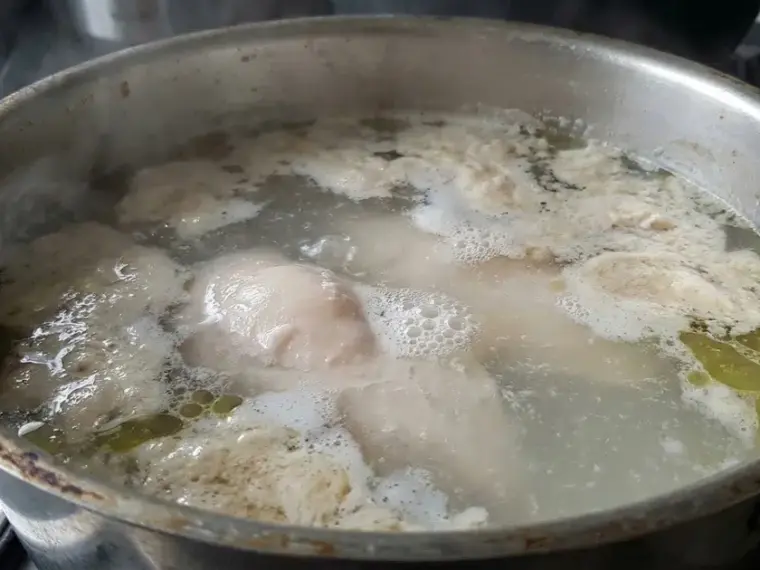
The first time I cooked chicken by boiling it, I panicked when a white foam began to form at the top of the pot. I recall looking at it, thinking that either the meat was bad or, worse yet, had been cooked in some sort of chemical compound. I almost threw the entire pot away.
It turns out, however, this is a very common reaction. If you’ve ever thought to yourself, “Why does chicken foam when I am cooking it?” you’re most certainly not alone. Fortunately, the white foam is typically nothing to be concerned about.
What Is That White Foam on Chicken?
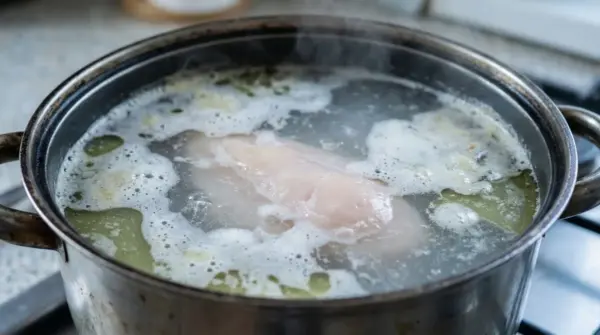
When I first saw the white foam, I thought it looked a little gross, similar to dish soap or cloudy goo. However, after researching it, I realized it’s much more normal than it seems. The white foam that forms when boiling or simmering chicken is primarily made up of denatured proteins. Specifically, it contains a type of protein called albumin.
When chicken is heated, these proteins unwind and rise to the top of the liquid, forming the bubbly and frothy appearance of the foam. In addition to proteins, there are some fats and naturally occurring impurities that mix into the foam. These items were simply present in the meat and bones.
Since this occurs more noticeably during boiling due to the constant motion of the water forcing everything to the surface, if you notice chicken foam while boiling, it’s okay to relax. It is not chemicals; it is simply the result of scientific processes taking place.
Is Chicken Foam Safe to Eat?
My major concern with chicken foam was whether it is safe to eat. After learning what it is, I no longer worried about it. To answer your question directly, yes, chicken foam is completely safe to eat. The foam is simply made up of natural components of the meat reacting to heat. Therefore, having white foam does not indicate that your chicken is spoiled, old, or contains unusual ingredients.
On the other hand, there are indicators that your chicken may be spoiled, and foam is not one of those indicators. These include, among others, if the chicken smells like ammonia or sour milk, has an unusual sliminess to it, or appears discolored (gray or green).
As a general rule, if you find that the chicken has a foul odor, is sticky or slimy, or has lost its normal color, it should be discarded immediately. However, white foam alone indicates nothing abnormal.
Why Does Some Chicken Foam More Than Other Chicken?
In my research, I discovered that not all chicken produces the same amount of foam when cooked. Based upon my own experiences, I found the following factors contribute to a greater amount of foam:
• Frozen chicken appears to release more water and proteins during cooking, which leads to more foam.
• Bone-in or skin-on chicken will produce more foam than boneless, skinless chicken. There is more material for the proteins to break down.
• Higher levels of protein, particularly in leaner cuts of chicken such as breasts, produce more foam.
• Boiling the chicken quickly instead of gently simmering will result in significantly more foam production.
Additionally, I found that there is some variation in foam produced based upon store-bought versus fresh chicken, but I would caution against jumping to conclusions. It is not indicative of “bad” chicken; rather, it reflects variations in how the chicken was processed or stored.
Will Foaming Affect Taste or Quality?
Here is the truth: the foam itself does not taste like much. It does not have a sour or unpleasant taste. However, if you are making a broth or soup and leave the foam in the liquid, the broth will appear cloudy and somewhat murky.
I have found that when I do not skim the foam off the top of the liquid, my broth loses that clear, golden quality. While it does not affect the taste, it does affect the visual appeal of the liquid.
Therefore, to achieve a clearer broth, I recommend skimming off the foam. Removing the foam will provide you with a cleaner-tasting broth, especially if you are making a light-colored broth or soup such as ramen, pho, or chicken consommé.
On the other hand, if you are making a hearty stew or shredding the chicken for taco salads, it is not a significant issue if you leave the foam in.
Should You Remove Chicken Foam? How I Do It
If you plan to create a clear broth, I highly recommend skimming the foam. Here is how I normally remove it:
I place the chicken in a pot and bring it to a gentle boil over medium heat. If you begin boiling it at high heat, it will produce foam quickly and become difficult to handle.
As soon as I notice the foam forming, I use a fine-mesh strainer or a large spoon to remove it. Skimming the foam can be slightly laborious, but it is also somewhat rewarding.
Once the foam subsides, I reduce the heat to low and allow the chicken to simmer slowly.
If I’m simply boiling chicken to shred for tacos or salads, I do not take the time to skim the foam. However, for any recipe that involves a broth, I highly recommend removing the foam, as it will improve the appearance and flavor of the broth. Please do not think that foam is “chemicals” or “toxic.” It is simply a matter of aesthetics and taste.
Common Myths About Chicken Foam
Now I’d like to debunk a few common myths regarding chicken foam:
• Myth: Foam means there are chemicals in the chicken.
• No, it’s simply protein and fat.
• Myth: Foamy chicken is not safe to eat.
• False. Foam is completely harmless unless there are other signs of spoilage present.
• Myth: You must discard it.
• Absolutely not. Like many people, I also believed some of these things prior to understanding what I was dealing with.
How I Prepare Chicken Every Time I Cook Chicken Now
So here is where I’ve arrived: when I am preparing soup or stock, I always remove the foam to obtain the clear broth that I desire. When I am boiling chicken quickly so that I can shred it for tacos or pasta, I ignore the foam. Regardless, I no longer panic when I see foam.
Because chicken is composed of proteins, and heat causes them to rise to the surface, why does chicken foam when you cook it? That’s it. It is simply a natural aspect of cooking that you can either deal with or ignore, depending on the recipe you are preparing.