
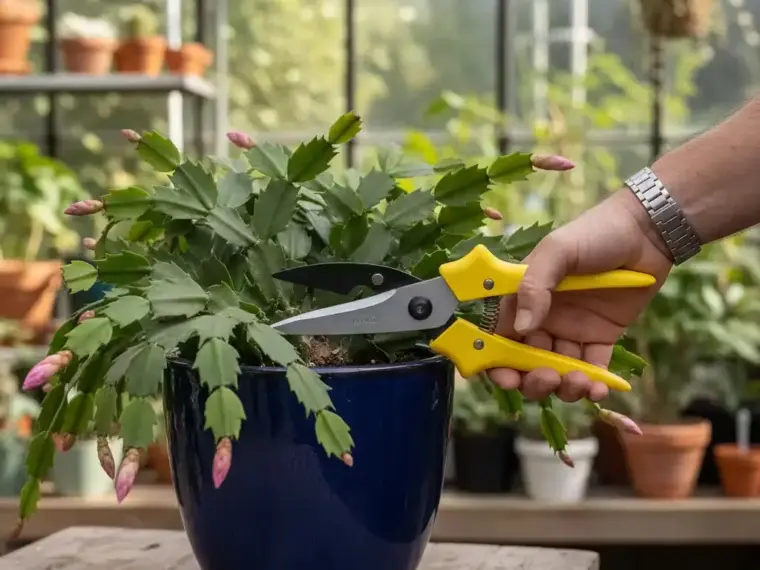
The vibrant blooms of a Christmas cactus (or its holiday relatives, the Thanksgiving and Easter cacti) are a cherished winter sight. But what happens when your festive foliage starts to look less “joyful” and more “jumbled”? Unlike other houseplants, these epiphytic cacti benefit immensely from occasional pruning, a practice that encourages new growth, better shape, and heavier flowering.
If you’re unsure whether to pick up the shears, look for these seven clear signals that your holiday cactus is ready for a rejuvenating trim.
1. The Overgrown or “Leggy” Look
The most obvious sign is an untidy, wild, or “leggy” appearance. If your plant has long, thin, drooping segments where the leaves seem sparse, it’s a clear signal that the plant is stretching out too far. Pruning these weak, elongated stems redirects the plant’s energy, encouraging a bushier, more compact, and visually appealing form.
2. A Lack of Blooms (Despite Buds)
If your Christmas cactus develops flower buds but fails to follow through with the show-stopping blooms, or if blooming is weak overall, it often suggests the plant is carrying too many unproductive segments. By removing some of the older, weaker foliage, you allow the plant to focus its limited energy and nutrients on the remaining, more vigorous parts, resulting in a more spectacular display next season.
3. Yellowing or Discolored Stems
Yellowing stems are a major red flag. This discoloration usually indicates that the stems are weakening, dying, or, most seriously, that a fungal disease is spreading silently through the plant. Pruning is essential here: it allows you to quickly remove all affected, diseased segments, preventing the infection from reaching the healthy core of the cactus.
4. Crowded and Tangled Growth
When a Christmas cactus becomes overwhelmingly dense, its segments can become tangled and matted. This crowded environment severely limits air circulation around the stems. Poor airflow traps moisture, which dramatically increases the risk of serious fungal infections and root rot. Thinning out the dense areas restores healthy air movement and ensures every segment receives adequate light.
5. Stunted or Weak Growth
It may seem counterintuitive to trim a plant that is already struggling to grow, but sometimes, slow or stunted growth is a sign that the plant is wasting energy supporting older, non-performing segments. Carefully removing only the weakest parts of the plant can stimulate new, vigorous growth, promoting rejuvenation and overall long-term health.
6. An Unbalanced or Lopsided Shape
If your cactus has started to lean dramatically to one side, or if certain areas are producing uneven, erratic growth, the overall shape of the plant suffers. Pruning is the simplest way to restore symmetry. By selectively trimming the longer or off-center stems, you bring the plant back into balance, giving it a tidier, more presentable look.
7. Persistent Pest or Disease Issues
Pruning can be an indirect method of pest management. If you’re consistently fighting off common houseplant pests or localized diseases, thinning down the foliage makes it harder for pests to hide and establish large colonies. By removing crowded sections, you create a less hospitable environment for pests, effectively helping to drive them away and making topical treatments more effective.
Taking Action: Safe Pruning Tips
If you’ve identified one or more of these signs, it’s time to act.
- Timing: The best time to prune a Christmas cactus is typically in the springtime or immediately following its natural blooming cycle.
- Tools: Always use clean, sharp pruning shears or scissors to make precise cuts.
- The Cut: To ensure a clean break, trim the cactus by snapping or cutting the stem at the joint, where two segments meet. This is the natural separation point of the plant.
- Propagation Bonus: Any healthy segments you remove can be easily propagated to start new plants!